Church of San Simeon Piccolo: a neoclassical treasure in the heart of Venice
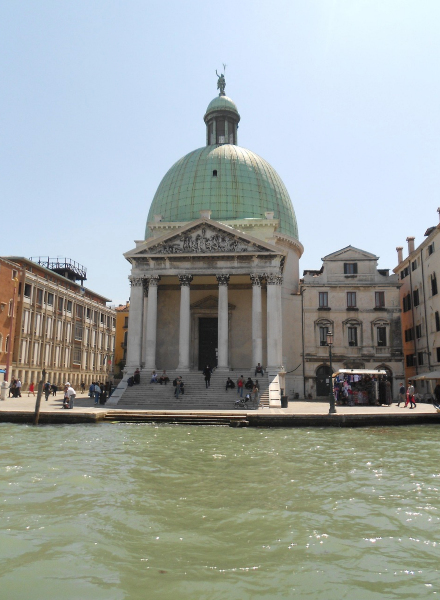
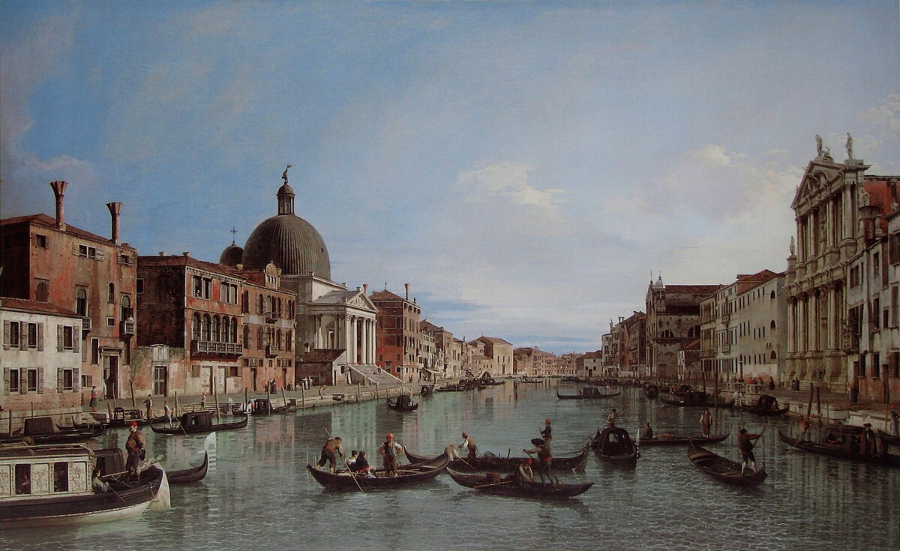
Arriving in Venice by train, the first thing that catches the eye of those leaving Santa Lucia station is a majestic green dome that stands imposingly right in front of the exit, on the other side of the Grand Canal. This is the Church of Saints Simeon and Jude, universally known as San Simeon Piccolo, one of the first and most striking monuments that welcome visitors to the lagoon city.
The name of the church itself contains a curiosity and historical irony that reveal its complex history: although today it is one of the most monumental buildings overlooking the canal, it is called “Piccolo” (small) to distinguish it from the nearby and less imposing church of San Simeon Grande, which was originally the larger of the two. This name contradiction is the key to understanding its history, which saw an ambitious 18th-century project that literally overturned the proportions between the two parishes, transforming the smallest into the biggest.
History: from its origins to Neoclassicism
The history of the church of San Simeon Piccolo has ancient roots, dating back to the 9th century and linked to the important Adoldi and Briosi families. However, the parish was established in the 11th century, with official consecration taking place on 21 June 1271. The original church was probably a three-nave basilica, oriented parallel to the Grand Canal, but in the 16th century, the building began to show signs of deterioration, leading to the radical decision to completely rebuild it.
The decisive turning point came in 1718, when the parish priest Giambattista Molin, known as ‘Manera’, promoted an ambitious rebuilding project, entrusting the task to the architect Giovanni Scalfarotto. The work lasted twenty years, until the solemn consecration on 27 April 1738, officiated by the Bishop of Cittanova d’Istria, Monsignor Gaspare Negri. To finance such a large-scale undertaking, the parish priest Molin used a decidedly unorthodox method: the organisation of a lottery with annual draws, a curious anecdote that testifies to the genius and determination necessary for the great civic projects of the time.
The church underwent other curious events in the following years. Under Napoleon’s Kingdom of Italy, in 1807, its chapter was suppressed: initially it incorporated the district of San Simeon Grande, but in 1810 the positions were switched, and San Simeon Piccolo was demoted to a secondary church.
The change in status and size of the two churches with the same name represents an interesting identity reversal. At a time when architectural grandeur was synonymous with power and prestige, the rebuilding of San Simeon “Piccolo” as an imposing and spectacular structure was a true declaration of urban supremacy.
Architecture, a mixing of influences
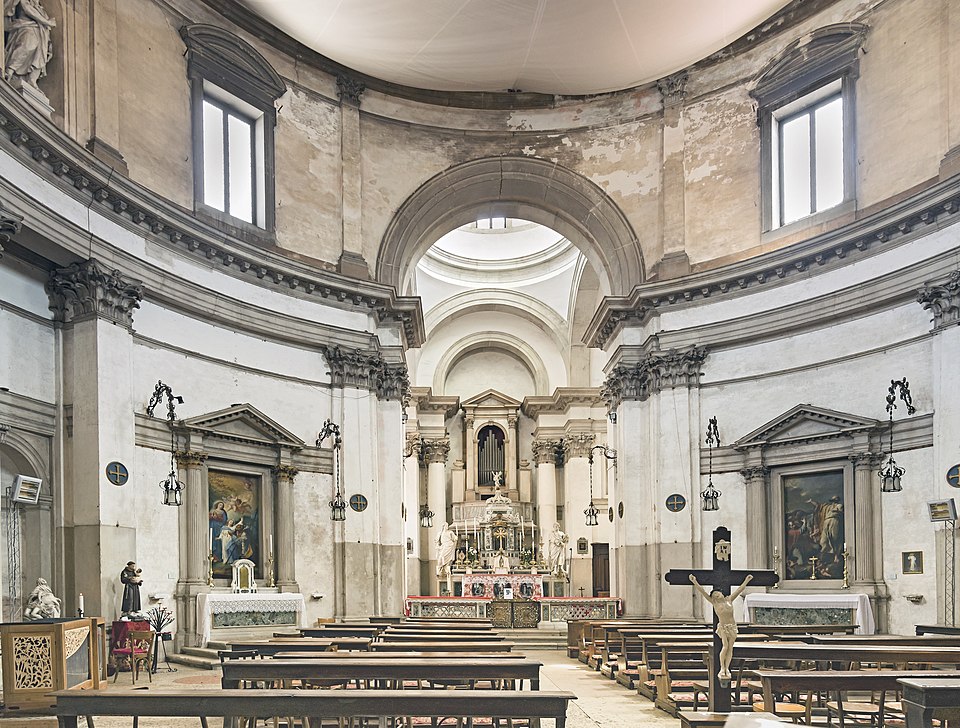
The church of San Simeon Piccolo is one of the most remarkable Venetian buildings of the 18th century, a period of stylistic transition between Baroque splendour and Neoclassical rigour.
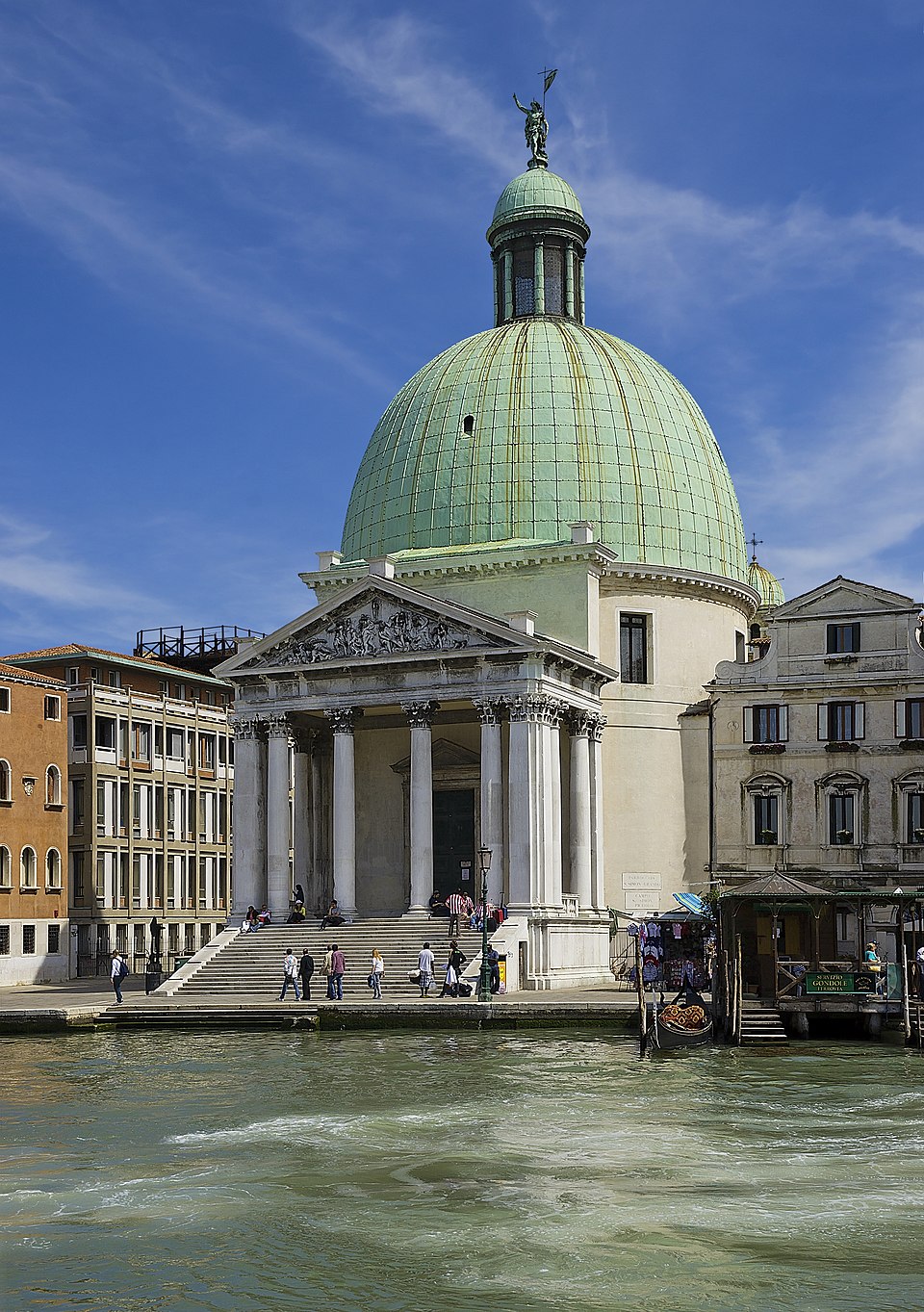
Its architecture is characterised by a central plan, an innovative and rare solution for the time in Venice, and a high dome covered with green copper that dominates the landscape of the Grand Canal. The imposing Corinthian pronaos (portico), accessible by a wide staircase, is clearly inspired by the Pantheon in Rome, a clear reference to the classicism that the architect Scalfarotto wanted to reproduce.
A detailed analysis reveals that the design is not just a simple imitation, but a complex mixing of different influences. Unlike the Roman dome, it has an oval shell that gives the entire structure a vertical thrust, further accentuated by the lantern that surmounts it. Furthermore, the rectangular presbytery, with its two apses, is reminiscent of the works of Andrea Palladio and Baldassarre Longhena, masters who defined Venice’s architectural identity.
The combination of classical, Byzantine and Palladian elements in a new stylistic vision makes San Simeon Piccolo an experimental building, a precursor of Neoclassicism in a city still tied to the Baroque style. Its design represents a clear reaction to excessive Baroque decoration and defines a new architectural language based on clean lines, harmonious proportions and rational elegance.
The Crypt, Venice’s underground secret
The most fascinating and unusual feature of San Simeon Piccolo lies beneath its floor: an underground crypt that forms a catacomb complex, a unique and rare feature in a city built on water. This burial space is organised according to the model of early Christian catacombs, with a central octagonal structure and a series of burial chapels arranged along two corridors. It is a place of deep mystery, housing the tombs of distinguished parishioners, whose identities are mostly unknown. An additional enigma is represented by the twenty-one chapels, eight of which are still walled up and unexplored.
The crypt is both a burial place and an underground art gallery that tells a story of spiritual and social evolution, with frescoes remarkable for their stylistic and thematic duality. The oldest paintings, dating back to the 18th century, show in soft colours delicate and spiritual scenes from the Way of the Cross, the Old and New Testaments.
Later, probably during the 19th century, the art of the crypt underwent a radical transformation. The new frescoes, with their darker and more macabre tones, dominated by blacks, reds and golds, portray skulls, bones and even a full-length skeleton painted in a niche. This dramatic change reflects a fascination with death and the occult that spread in the 19th century, at a time of profound upheaval for traditional religious institutions.
Unfortunately, this extraordinary space is not currently open to visitors and will remain closed to the public until it is safe to visit.
The Priestly Fraternity of St Peter and the Mass in Latin
Today, the Church of San Simeon Piccolo is under the pastoral care of the Priestly Fraternity of St. Peter, which has been celebrating the liturgy there since 2006 according to the Extraordinary Form of the Roman Rite (Tridentine Mass). This assignment, desired by the Patriarch of Venice, Cardinal Angelo Scola, has made San Simeon Piccolo the only church in the city where Mass is still regularly celebrated in Latin.
The Priestly Fraternity of St Peter is composed of Catholic priests who, while not taking religious vows, work together for a common mission. Their purpose is twofold: the priests’ formation and sanctification according to the traditional Latin liturgy, and the pastoral care of souls.
The celebration of Mass according to the ancient rite represents a continuity with centuries of Catholic liturgical tradition and offers the faithful and visitors a religious experience of particular solemnity and depth. The austere beauty of the Latin liturgy, with its Gregorian chants and ceremonies, finds a perfectly suited setting in the neoclassical framework of San Simeon Piccolo, creating a harmony between architecture and spirituality.
It is possible to attend Holy Mass in Latin every day at 11:00 a.m.
How to reach San Simeon Piccolo from Camping Ca’Savio
From Camping Ca’Savio the route to the Church of San Simeon Piccolo is very scenic: after reaching the pier in Punta Sabbioni – by bus, bicycle, or car, depending on your needs – simply take the boat towards Venice-San Zaccaria (a stone’s throw from St. Mark’s Square!). From here, you can choose to enjoy a pleasant 30-minute walk or take a vaporetto along the Grand Canal to the Santa Lucia train station, right in front of the Church of San Simeon Piccolo.
During your stay at the campsite, a visit to this architectural treasure would be an opportunity to discover an unusual and fascinating side of Venice, far from the most popular tourist routes but rich in history and spirituality.